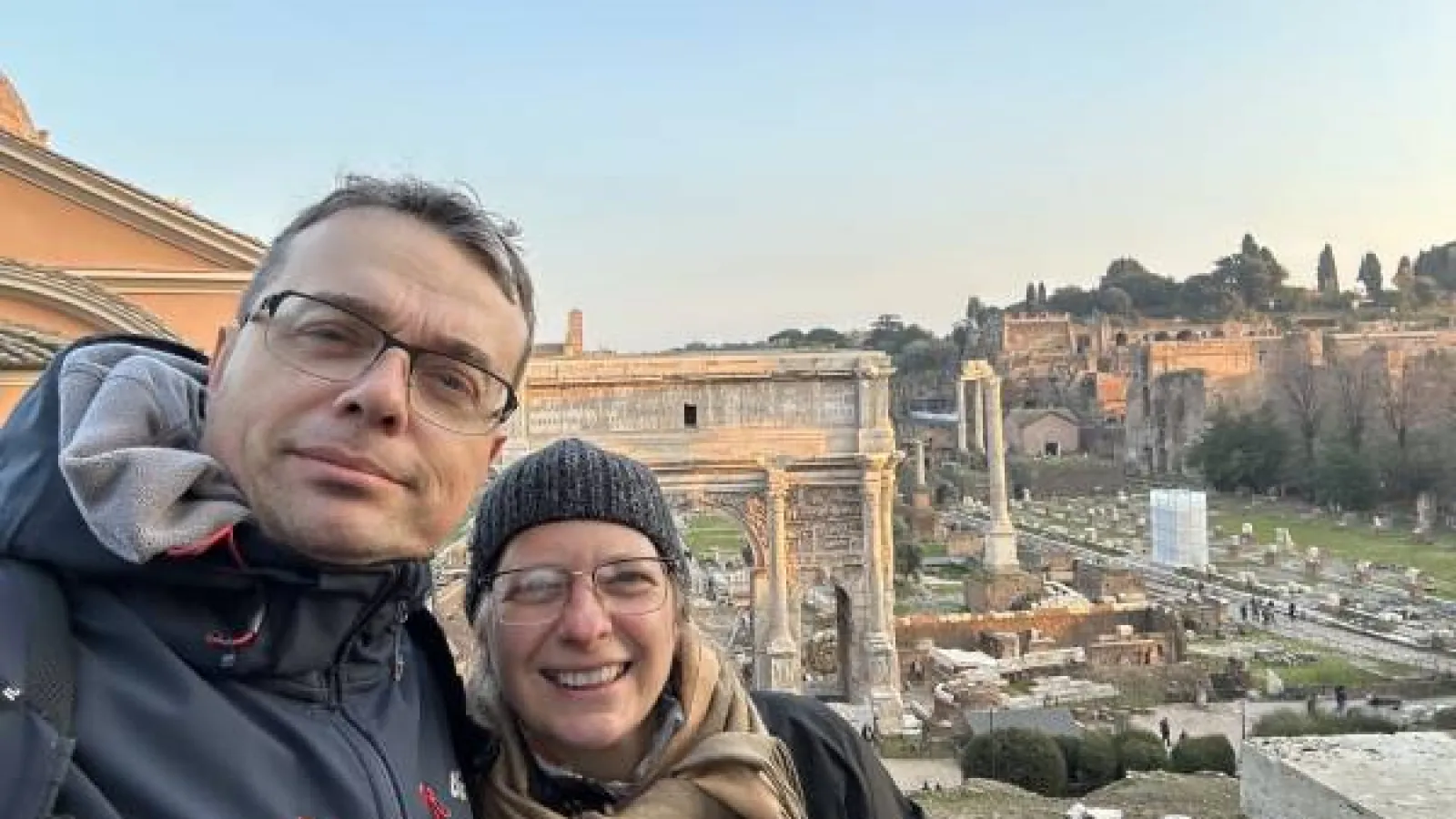
Please join CSEEES in welcoming visiting faculty from the University of Warsaw, Professor Marcin Wojciech Solarz from the Faculty of Geography and Regional Studies and Dr. Anna M. Solarz from the Faculty of Political Science and International Studies for a special lecture entitled "Poland’s Solidarity: Idea and Spatial Memory: The Polish idea of universal brotherhood and its impact on historical memory and international relations."
Abstract: The history of Poland in the 250 years separating the present day from the beginning of the reign of the last king of Poland (1764) has been a real rollercoaster. In 1772-1795, Poland was erased from the political map of Europe for 123 years. In 1918, Poland regained independence, only to fall again in 1939 and be divided between Germany and the USSR. After the end of World War II, Poland became a state subordinated to the USSR. For the second time in the 20th century, Poland regained independence in 1989 thanks to the ‘Solidarity’ peaceful revolution.
‘Solidarity’ was a global phenomenon that gathered almost 10 million employees and was strongly linked to religion, but was completely open to all for whom truth and freedom were important, including atheists and leftists. It remains a symbol of Polish "open history", which inspired the greatest geopolitical changes in the 20th century. For this reason, it is worth paying particular attention to the Polish version of the idea of "brotherhood" or "fraternity”, which, as the "missing element" of modern liberal society, is beginning to be noticed again around the world.
The turbulent history of Poland is reflected in the public space of its capital, Warsaw. Each occupier, regime or authority tried to shape the downtown of the Polish capital in such a way as to show its own citizens and foreigners its power over the political heart of Poland, and therefore over the entire country. The presentation traces changes in the political language of public space in the downtown of Warsaw on 8 map-schemes. Different narratives are shown in different colors, imposed on public space, leading to the shaping of the contemporary political landscape of Warsaw.
The Solidarity Memorial in Warsaw was not erected until the 32nd anniversary of Poland regaining its independence in 1989. Since 1989, Warsaw has failed to erect a visible symbol of the peaceful Polish revolution of the 1980s, which is highly symptomatic. Nevertheless, it managed to create one of the best monuments built in Warsaw after 1989. Noteworthy is not only its central part, physically connecting the symbol of Solidarity with the Berlin Wall, but also the entire surroundings of the monument, which create a context expressing both the dynamics of the Polish revolution of 1980 and the international situation at the time, revealing the forces that contributed to changing history less than 10 years after the forcible suppression of the Solidarity revolution in 1981.
Speakers:
Dr. Anna M. Solarz is a researcher at the Faculty of Political Science and International Studies, University of Warsaw. In 2017, she was a visiting scholar at the Mershon Center for International Security Studies at The Ohio State University. Since 2010, she has co-organized the annual Multidisciplinary Conferences of the Faculty of Political Science and International Studies, University of Warsaw, and the Divine Word Missionaries: The Sacred and the Profane in the Contemporary World. She has lectured at universities in Columbus, Izmir, Konya, and Haifa, among others. She has participated in research grants, including Forest Germans (Walddeutsche): the past and present of forgotten local communities in the Carpathian Foothills. Anna Solarz is the author of numerous publications on the integration of religion into the study of international relations. She is an activist in the "Solidarity" trade union and, since 2023, has been the vice-chair of the NSZZ "Solidarity" Trade Union Commission at the University of Warsaw. For years, she has conducted research on religion in international relations, international relations in the Middle East and Central and Eastern Europe, the Holy See in international relations, and Israel's foreign policy.
Prof. Marcin Wojciech Solarz, PhD (dr habil.) is a geographer, political scientist and IR researcher at the Faculty of Geography and Regional Studies of the University of Warsaw, Poland. Head of the Department of Political and Historical Geography, FGRS UW. Head of the project “Deaf/Forest Germans (Walddeutsche): the past and present of forgotten local communities in the Carpathian Foothills”, 2020-2025, and “Forest Germans (Głuchoniemcy, Walddeutsche, Taubdeutsche) in the Little Ice Age: Mobility Structures and Natural Environment”, 2025-2029. Author of “The Language of Global Development. A Misleading Geography”, “The Global North-South Atlas: Mapping Global Change”, “Geography and the World’s Development Divides” in “Elgar Encyclopedia of Development” and “The 1914–2024 War Atlas: Modernity Deciphered Anew”, and other works; as well as scientific editor and co-author of “Atlas of Poland’s Political Geography. Poland in the Modern World” (2018; 3rd place in the “Atlases” category at the International Cartographic Exhibition in Japan in 2019), “New Geographies of the Globalized World" and “Atlas of Poland’s Political geography. Poland in the Modern World: 2022 Perspective”.
This talk is organized in conjunction with INTSTDS 5196/Polish 5196: Topics in Polish and European Culture. Attendance is free and open to the public.
If you have any questions about accessibility or wish to request accommodations, please contact CSEEES at cseees@osu.edu. Typically, a two weeks' notice will allow us to provide access, but we will try to accommodate requests that come in after the two week mark.