How the War is Increasing LGBTQ+ Acceptance in Ukraine
Ukraine has historically not held a lot of support for the LGBTQ+ community. One 2016 study by the Kyiv International Institute of Sociology found that approximately 60% of Ukrainians held negative attitudes towards the LGBTI community , and only 4% viewed them positively. The rest of the participants in the study were neutral towards them. The same study revealed 45% of Ukrainians believe there should be a restriction on LGBT rights. However, the data shows that the opinion of the LGBT in Ukraine is rapidly changing. In 2025, 33% held a negative view towards the community, with 18.6% viewing them positively - over four times what it was in 2016. The number of Ukrainians who feel that LGBT citizens should have equal rights is at 78.1%.
The driving force behind this change? The Russo-Ukrainian War.
The Russo-Ukraine war has caused a variety of changes in Ukrainian society, and this is one of them. This stark increase in acceptance of the LGBTQ+ community can be largely tied to Ukraine's desire to be anti-Russian. One of Russia’s many justifications for invading Ukraine was the claim that it would fight Western “moral decay” and protect “traditional values”. Since 2013, Russia has passed a "gay propaganda" law, banning the propaganda of “non-traditional” sexual relations. In 2020, there was a ban on same sex marriage. Russia utilizes homophobia, cultivating a desire to protect Russian culture from the LGBTQ+ community, which helps the public perception of the war and garners hatred towards Russia’s enemies. To be anti-LGBTQ is to be pro-Russian. One website, which has been credited to the Russian Secret Services, contains a video game where players are asked to shoot at helmets with flags from NATO, Ukraine, and the rainbow flag. Russia’s invasion has been perceived as a fight between “liberal democracy and authoritarianism”, thus “many Ukrainians see the move towards greater equality and inclusivity as part and parcel of its shifting orientation towards Europe and the West”.
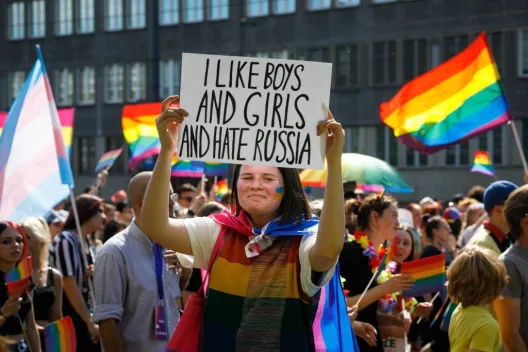
A photo posted by KyivPride, a non-profit to promote LGBTQ+ rights in Ukraine, via X/Twitter.
It is not uncommon for victims of imperialism to double down on the cultural values they are being attacked for. When certain ideologies become a justification for imperialism, countries tend to associate those views with their oppressors. In recent years, colonizing countries typically use liberal ideologies as a rationale for their actions. For example, the U.S. often uses concern for women’s rights to legitimize its intervention in other nations. There is also pinkwashing, the use of LGBTQ+ rights in Israel to defend its actions in Palestine. What makes Ukraine’s case interesting is that, unlike these other examples, conservative rhetoric is being used to justify its occupation, making it more progressive as a result.
This isn’t the only way the Russo-Ukraine war has led to an increase in LGBTQ+ acceptance in Ukraine. Arguably, the most important reason for Ukraine’s increase in tolerance is the number of LGBT+ soldiers, which is aided by the media’s coverage of them. Many Ukrainian soldiers still do not feel free to discuss their sexual orientation, but they are estimated to comprise between 5-10% of the military. The war is also arguably prompting closeted soldiers to come out. Max Potapych, media manager of LGBT+ military, states that “Our queer soldiers understand that they may lose their lives really fast, and they didn’t live a life as freely as they could without war… It motivates them to come out despite all the homophobia.” More coming out stories increase the visibility of LGBTQ+ individuals in the military and society as a whole. This positive representation is changing the way Ukrainians view LGBTQ+ individuals.

Ukrainian soldiers take part in the Equality March, via PBS News
Despite all this, Ukraine still has a long way to go before achieving equality. The war has also put Ukraine in a state of chaos, which makes it difficult for LGBTQ+ individuals to obtain certain rights. President Zelensky has expressed a desire to legalize same-sex marriage, but claims that changing the constitution cannot take place during the ongoing war. While far more Ukrainians support registering same-sex couples, it is still only 29.8%—less than half the population. Many far-right and religious groups in Ukraine also frequently attack the LGBTQ+ community. A famous and controversial Ukrainian priest claimed that a pride march was responsible for the Russian attack on Kyiv a few days later, calling it a ‘punishment from God’. Extreme right groups even claim that the LGBTQ+ community is more of a threat than the Russians.
Soldiers in Ukraine are risking their lives for a country that does not fully recognize them as equals. Hopefully, this trend of increasing equality for the LGBTQ+ community continues long after the war.
Aurora Malave, CSEEES Spring 2026 Intern, is a junior at The Ohio State University double majoring in International Studies and English. This article was developed as her final research project for her CSEEES internship.
