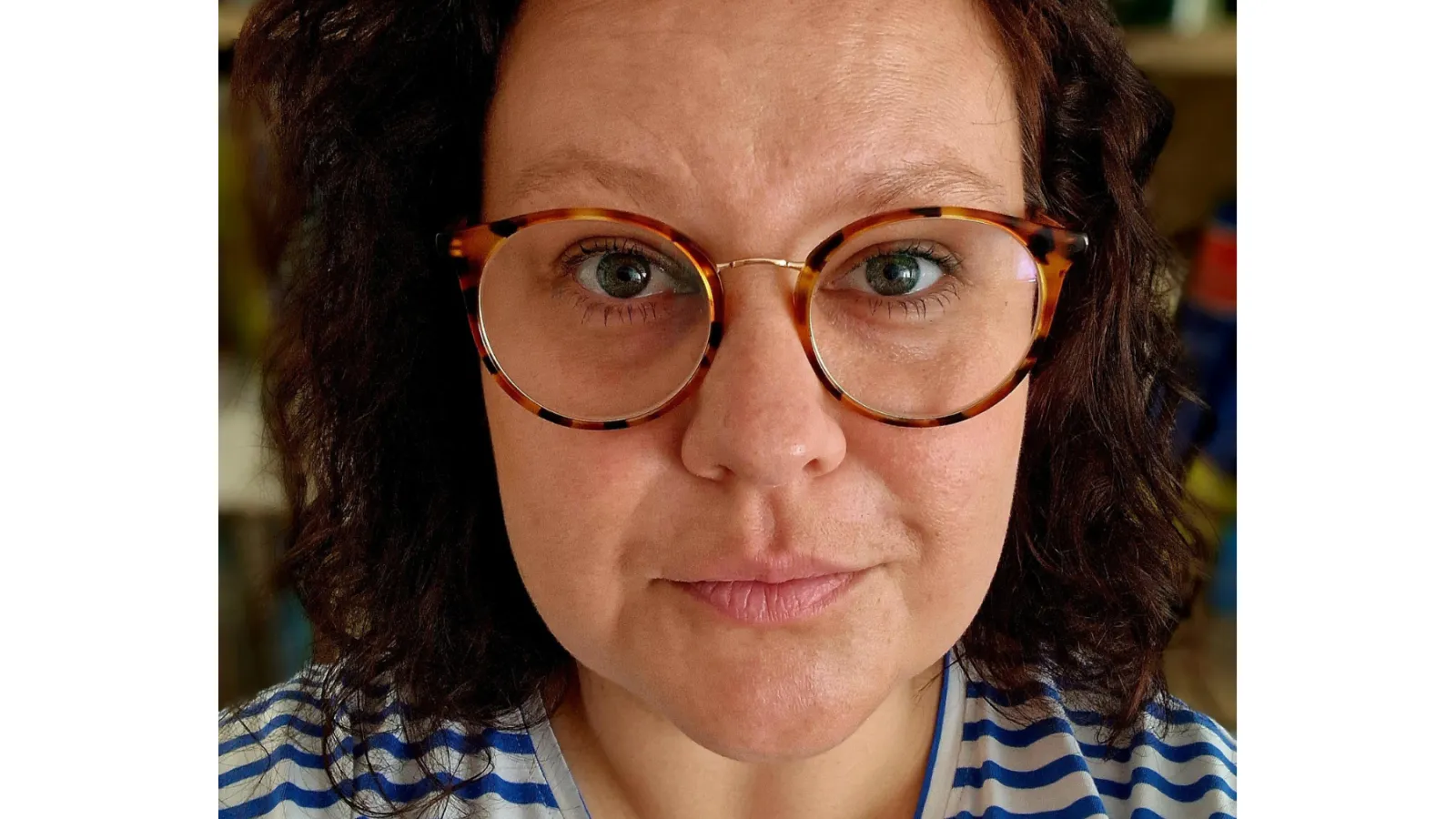
Scrolling with a Purpose: An Interview with Fulbright Scholar Aleksandra Urzędowska
What motivated you to participate in the Fulbright program at Ohio State?
I wanted the opportunity to conduct research in a place that was unfamiliar to me, and the United States felt like the right choice. American culture was something I knew mostly from a distance, and I was curious to experience it firsthand. I also wanted to immerse myself in an English‑speaking environment. I knew my English was functional, but I wanted to push myself to live and work in a community where I had no choice but to use it every day. Another motivation was my interest in media. I wanted to understand how American media works from the inside, not just through observation from abroad. Once I arrived, I realized how different the perspectives, interests, and ways of telling stories truly are. Even when the topic is similar, the angle, the voice, and the production choices differ. That firsthand exposure is exactly what I hoped for.
Teaching Genres of Digital Media at Ohio State involves comparing Polish, European, and American journalistic genres and perspectives. From your perspective as a Polish scholar who has a “special fondness” for American digital reportage, what is it about the American approach to digital storytelling that stands out to you, and how does it differ from Polish and European media?
What stands out to me first in the American context is the level of polarization. The same event can be framed in very different ways depending on the outlet, and that shapes not only public debate but also storytelling choices—tone, emphasis, narrative angle. You really feel that media are part of an ongoing conversation, sometimes even a confrontation. But what currently interests me most is digital reportage. And here I see a more structural difference. In the European tradition, reportage is still treated quite classically. Even when it becomes multimodal, it usually remains linear—it unfolds like a book, with a clear beginning, middle, and end. The experience is structured and sequential. In the United States, digital reportage can feel much more architecturally designed. It’s not just a journalist writing a text. There are often UX designers, multimedia teams, interactive elements—people shaping how the story is experienced. As a result, the structure becomes more networked and modular. You don’t just read; you navigate. You scroll through layers of text, visuals, sound, and data. For me, that’s a noticeable difference—but it doesn’t describe entire media systems. It applies to specific digital formats that I’m particularly interested in. That’s the space where I see the most fascinating experimentation.
You’ve mentioned that comments are never “just comments” but micro-genres where identities and values are negotiated. How do you define a micro-genre in this context?
Genres are structured modes of communication such as journals, broadcasts, articles, and books that shape how information is organized and delivered. Comment sections operate as micro‑genres—less structured and less regulated methods of communication that reveal how people understand themselves and their communities. Across platforms, people use comment sections to express identity, emotion, and social belonging. These spaces invite opinion sharing, advice seeking, playful interaction, and even self-promotion. Comment sections everywhere are a creative space where people negotiate identity, authority, and credibility.
You’ve lightly teased about turning social media browsing into a legitimate academic lifestyle. For students who spend hours on these platforms every day, what is one habit they can adopt to start seeing their feed as an educational resource rather than just a source of entertainment?
One simple habit students can adopt is to pause before they start scrolling and ask themselves a guiding question. Instead of letting the algorithm decide what appears, they should take a moment to set an intention. “What am I looking for right now?” or “What do I want to learn from this?” That brief reflection shifts scrolling from passive consumption to active inquiry. Before opening a video or post, students should consider what purpose it serves. Scrolling becomes more deliberate, almost like informal research, where students are paying attention not just to the content but to its purpose, audience, and technique. This habit doesn’t require extra time or effort. It simply reframes the feed as a space for learning rather than letting the algorithm pull you into endless, aimless scrolling. In that way, “scrolling with a purpose” turns everyday browsing into a small but meaningful academic practice.
Many people now scroll straight to the comment section before reading the article to find the “real story.” With the emergence of AI generated social media accounts and comments spreading false propaganda and misinformation, what challenges does this create for the journalist community? What can people do to combat this issue and ensure that they are receiving credible information?
The comment section is a supplement rather than a substitute for real information. However, many people no longer feel motivated by headlines to read the full story. They assume the comments will reveal “the real story,” even though comments are often disconnected from the reporting. You can usually tell when someone hasn’t read the piece. They react only to the title or to another commenter, not to the journalism itself. AI generated comments make this dynamic even more dangerous. Bots can mimic real users, amplify propaganda, and flood discussions with manufactured narratives. This makes it harder for audiences to distinguish informed commentary from noise. When people trust the comments more than the reporting, journalists lose their authority as trained and ethical professionals. Solving this problem requires two things. First, journalists must produce compelling headlines and strong, accurate, and engaging work that compels the readers to read the whole story before they react. Second, we need media literacy education from an early age. Many people cannot tell what is real, fake, or AI generated online. Teaching students to verify sources, crosscheck information, and recognize credible reporting would help them navigate a digital environment where anyone can post anything.
In what ways does the journalistic genre keep changing? What causes this and how do you anticipate it to evolve in the future?
Journalistic genres have always changed over time, especially when new technologies emerge. Print journalism was followed by radio and television, which was followed by the internet. The internet sped up the pace of these changes in genres, making new formats and platforms emerge much more quickly. Every day brings a new tool or method for audiences to interact with information. What drives these changes is technology and the ways people use media in their everyday lives. Social platforms have turned journalists into both reporters and performers, adapting their work to algorithms, attention spans, and the engagement of their audience. Predicting the future of journalism is extremely difficult. New innovations, whether driven by artificial intelligence or by human creativity, will continue to emerge in ways we cannot fully anticipate. What seems likely is that journalism will preserve some traditional formats while others may be reshaped into completely new formats that we haven’t seen before. Although the methods of delivery will keep changing as technology, culture, and audience habits evolve, the core values of journalism—investigation, storytelling, and public accountability—will remain constant.