Art and Politics Under Dictatorships: An Interview with Dr. Caterina Preda
Dr. Caterina Preda’s education started in the arts, attending an art school for over 8 years. But once she enrolled in the University of Bucharest, she started studying political science, and a transformative Erasmus experience in Rome introduced her to comparative politics. She started comparing the Romanian Ceaușescu dictatorship with regimes in the Balkans, the Middle East, and eventually Latin America. Combining her interests in Eastern Europe, Latin America, and art led to her PhD topic:
“The idea was to try to answer this question: How come in very different political contexts, the right-wing military dictatorship in Chile and the left-wing theoretically Marxist dictatorship in Romania, we have these very different models of intervening in the art sphere, but in the same logic. So, my thesis was that the dictatorship, no matter if it's on the right or on the left, always does something in relationship to the artistic world because artists hold this power of showing how reality works and how real life is under a dictatorship.”
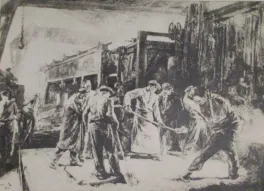
During her doctoral investigation, Preda worked on the group research project From the “state artist” to the artist dependent on the state: The Union of Visual Artists (of Romania) which explored the impact of Romanian artists’ unions during and after communism. Artists’ unions were state-controlled organizations that gave artists studios, stipends, and exhibition spaces, but required them to follow communist guidelines. But after the fall of communism in 1989, these unions and artists had to navigate their new freedom.
“The creative unions were transformed into [non-governmental organizations] after 1990. But after 2000, these NGOs are called NGOs of public interest, which means that the state still supports them in a way. And this is why I also talk about this artist in Romania who is still dependent on the state. The artist cannot break with this kind of conditionality from the state because the art market is created very slowly and it's very difficult to establish it. And so artists still expect the state to give them something.”

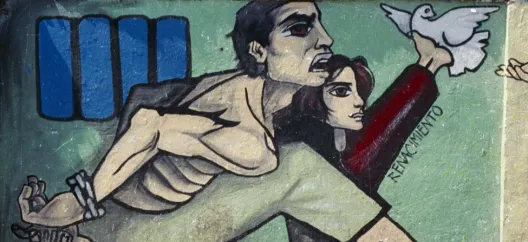
Preda proceeded to publish her 2017 book Art and Politics Under Modern Dictatorships, which again used the cases of Chile and Romania to explore artistic resistance against repression. She emphasizes that the value of this comparison is not their similarities but their differences. In fact, she chose to use Chile as the comparative counterpart because of Chileans’ propensity to protest, the very opposite of the Romanian experience. Preda stated, “The contexts are very different. And so artists' types of resistance to power were also very different. But I think by looking at these two extreme cases, the Chilean on one side and the Romanian on the other, we can see this range of possibilities that artists have.”
She went on to clarify, “From today's perspective, it could sometimes be difficult to understand why I call a certain artistic work in the Romanian case an artwork that is against the dictatorship or that expresses this kind of resistance, because sometimes the gestures are very minimal, artistic gestures ... There is a range of types of resistance to dictatorships. And they are the result of the historical experience of the country”
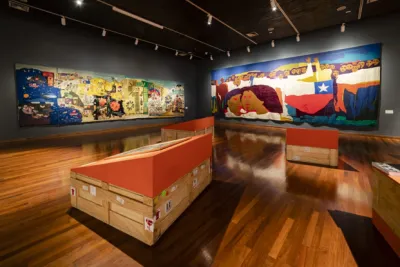
Today Preda continues to focus on Chile, publishing Transnational socialist encounters in the Second Socialist World: the case of the Chilean Museum of Solidarity, a 2024 research article that analyzed the role of the Chilean Museum of Solidarity as a source of empowerment and rebellion. The Chilean Museum of Solidarity was created in 1971 to build a public international art collection donated by artists all over the world. Preda emphasized that artwork came from the Western world just as much, if not more, than from Eastern European socialist countries. The museum was not created to platform socialist propaganda but rather to build transnational connections and a diverse museum. After Pinochet came to power, the museum was shut down but reestablished abroad.
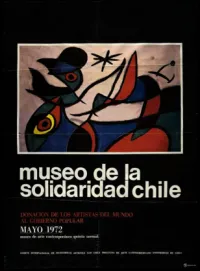
Preda explained, “This Museum of Solidarity, after the military intervention in Chile in September 1973, also became a sort of resistance to the dictatorship in Chile established by Pinochet because it traveled to Paris and then to Havana. And it became this kind of forum to organize events against the military dictatorship. So it provided this kind of framework to think the world differently than it was seen until then."
Most recently, Dr. Preda co-published Plural and Multiple Geographies of Modern and Contemporary Art in East-Central Europe which questions the different names and representation used for the East-Central European region. Preda asks, “How can we conceptualize this region that also had this communist experience, differently than what has traditionally been called Western Europe, and how do that heritage and that experience make us very different in a way? It was this idea of questioning geography and trying to bring back into the discussion terms that were used during communism and create this alternative geography.” The book argues that by using plural and multiple geography perspectives, we can better understand representations of the region and what change means.
If you’d like to hear more from Dr. Preda, please join us for her guest lecture “A Doctor, an Artist, a Spy: Corneliu Petrescu in Ceaușescu’s Romania in the 1970s and 1980s” with Caterina Preda on Monday, October 19th from noon to 1:30 p.m. in 160 Enarson Classroom Building.